Share how you feel
Record a short voice note whenever you need to express what is on your mind.
UX/UI · Product design · DKS project
An asynchronous, anonymous voice-message app helping older adults express themselves, listen to others, and feel accompanied . without pressure or real-time exposure.
Many older adults experience everyday loneliness not as total isolation, but as the lack of a safe space to express themselves freely.

An anonymous, asynchronous voice space where older adults can share, support someone or simply listen.
Record a short voice note whenever you need to express what is on your mind.
Offer a brief, empathetic response whenever you feel ready.
Feel accompanied by others’ voices without having to speak or respond.
Emotional support, companionship and community products.
Adults aged 65 80 with basic mobile literacy.
Semi-structured sessions lasting 20 25 minutes.
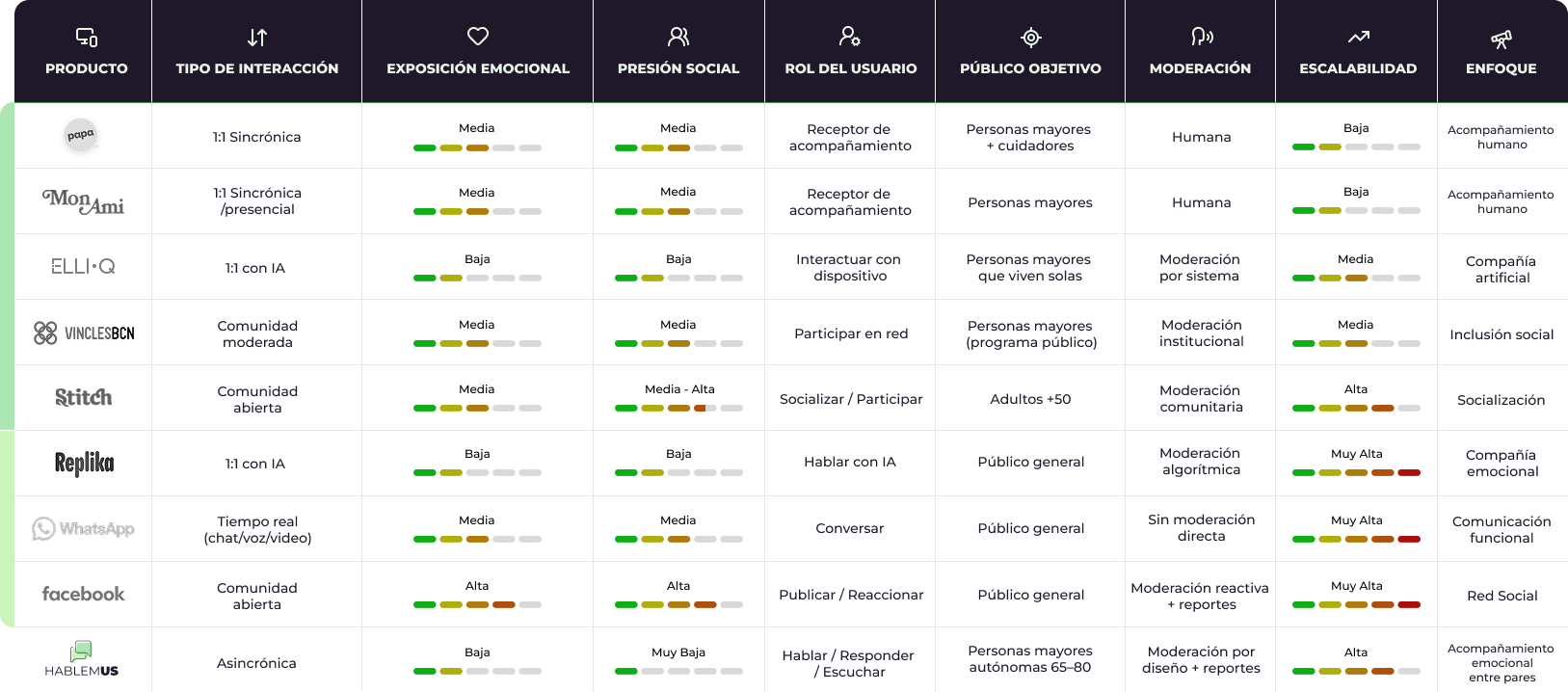
Benchmark comparing emotional exposure, social pressure, moderation and scalability.
No existing product combined anonymous voice, asynchronous support and peer-to-peer companionship for older adults.
48 older adults between 65 and 80 participated in the research. The findings revealed a clear emotional need, while also confirming that a simplified mobile experience could be realistic for the audience.
76% have felt lonely at some point in their daily life.
66% rarely or never talk about how they feel when loneliness appears.
When they do speak, 61% do it mainly to vent, more than to seek advice.
The opportunity was not only emotional. Mobile familiarity suggested that a guided, simple and voice first product could be realistically adopted.

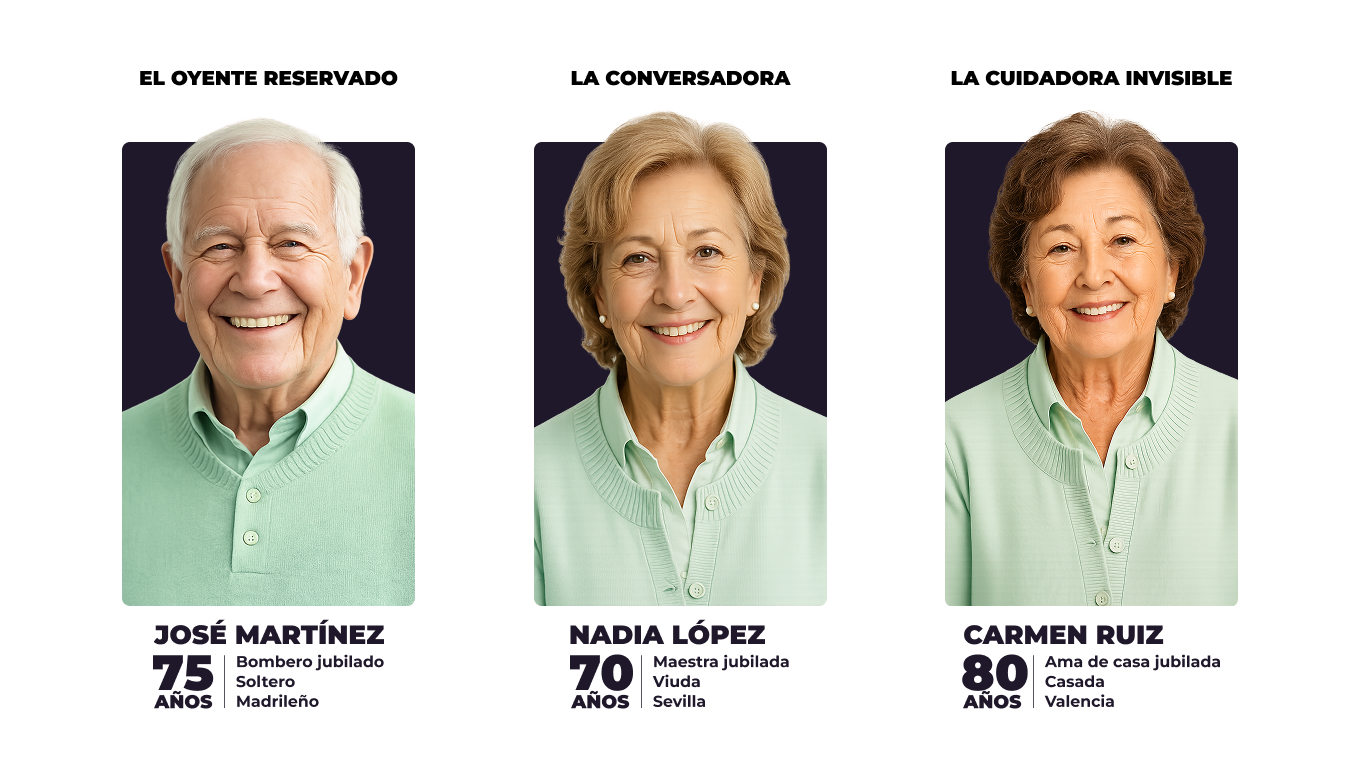
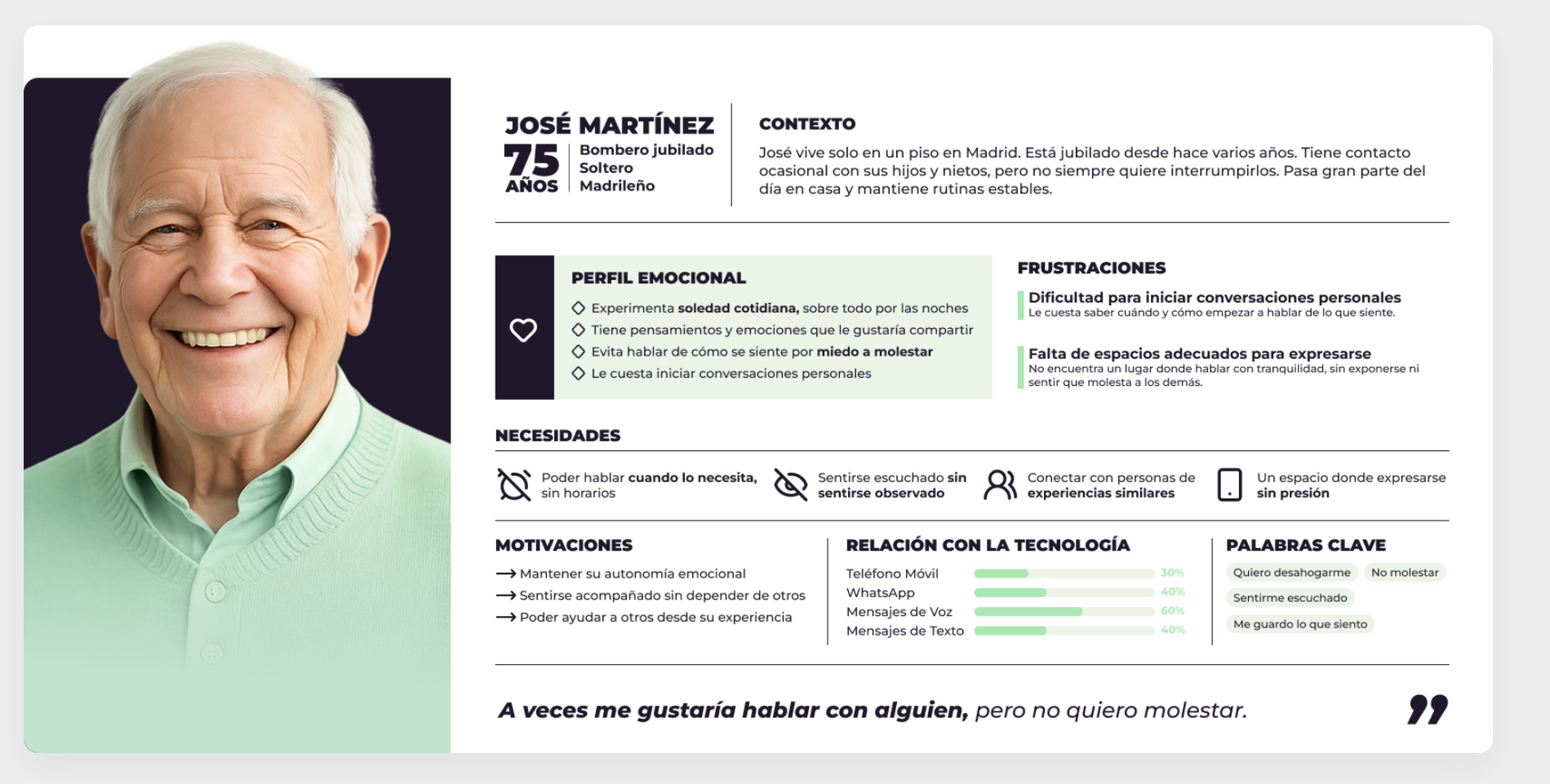
José, Nadia and Carmen represent three emotional entry points into loneliness. Their differences helped define a product space where all three options sit side by side without hierarchy.
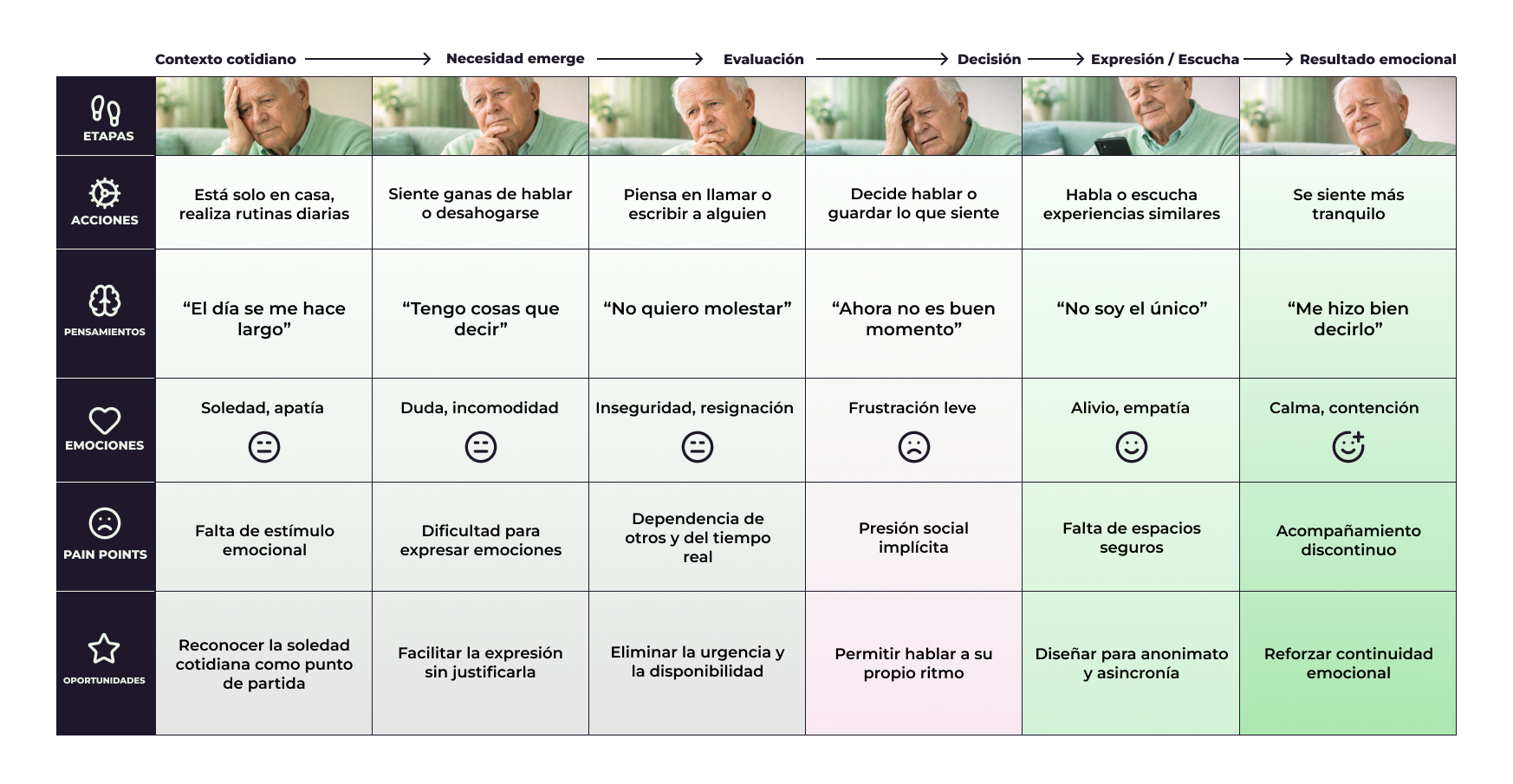
The biggest opportunity sits between Decision and Expression. Removing urgency and social pressure allows someone to move from hesitation to speaking up.
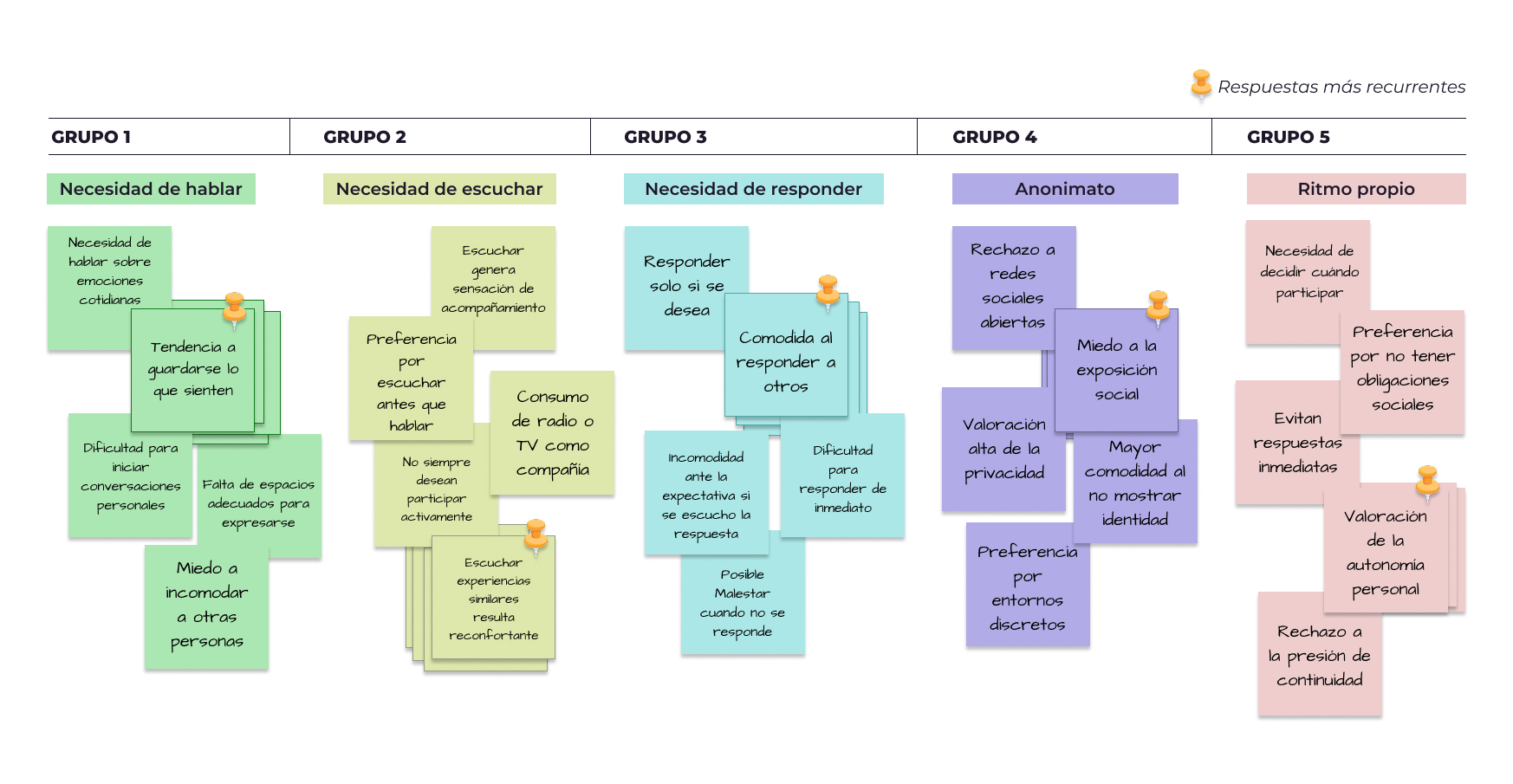
Fear of bothering others blocks expression.
Listening alone provides emotional company.
Welcome only when voluntary and pressure-free.
Reduces exposure and enables honesty.
Control over when to participate is essential.
Each insight became a “How might we” question . a starting point for generating concrete ideas before prioritizing anything.
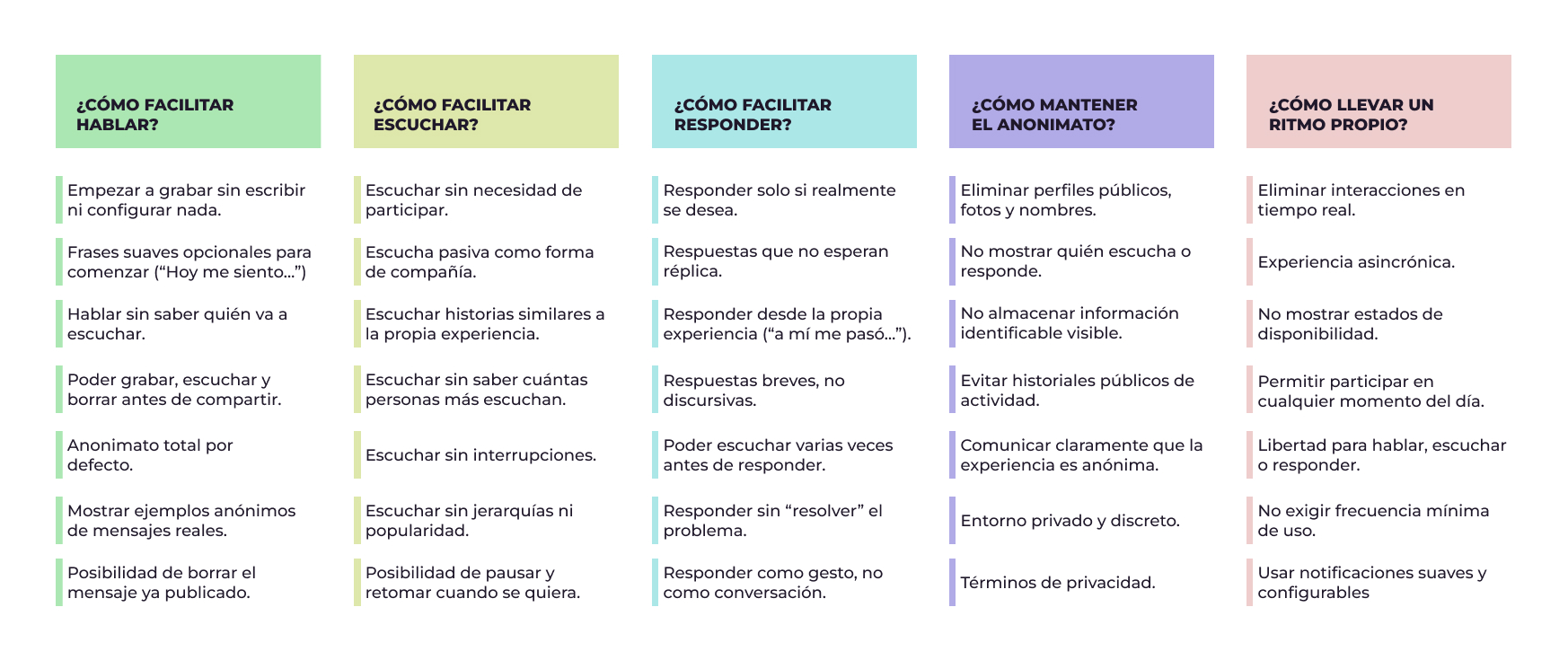
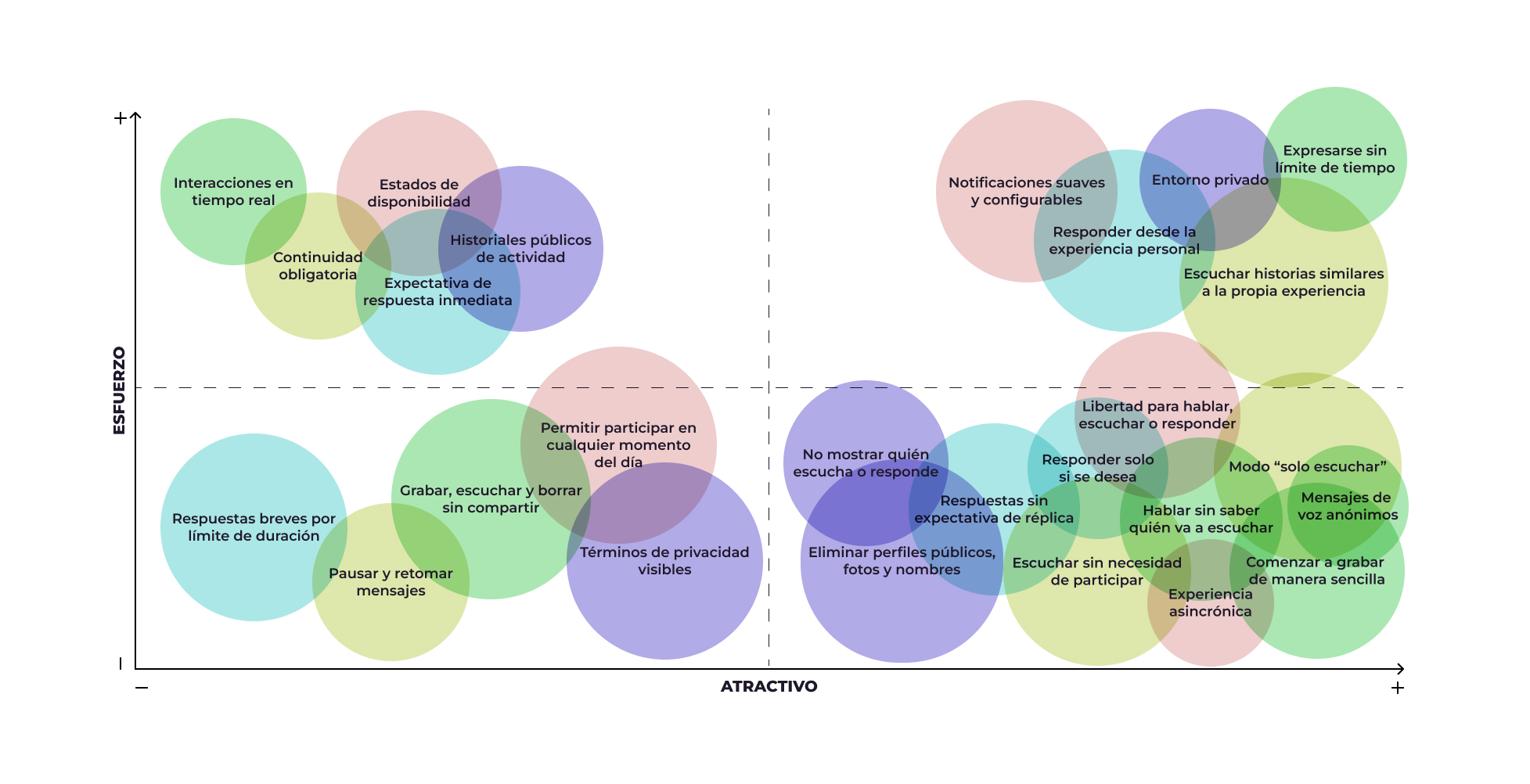
An Effort vs. Impact matrix defined an MVP centered on expression, listening and voluntary participation.
Anonymous voice messages
Listen-only mode
Optional responses
Asynchronous experience
Matching by experiences
Empathetic response guides
Advanced moderation
Mood-based recommendations
Real-time interactions
Popularity rankings
Mandatory continuity
Fixed listener/speaker roles
A safe, anonymous space where older adults can express themselves, feel heard or accompany others through voice messages, without pressure, in their own time.

Before prototyping the product, I validated whether the concept was understandable, desirable and trustworthy. The goal was to confirm that the framing, promise and emotional value were strong enough to move forward.
Participants recognized safety, anonymity, listening and expression as the product's core value.
Positive intent exceeded the validation threshold.
Every participant completed all six steps without dropping off.
Interest depended on clear moderation, anonymity and a genuinely protected environment.
60% said the proposal fit them completely. The remaining 40% answered “more or less”.
All concept KPIs met or surpassed the expected thresholds. A strong signal to continue into prototyping with confidence.
To keep the exercise accessible, I ran the activity face to face using printed cards. The goal was to understand how participants grouped features, interpreted labels and expected the structure to work.
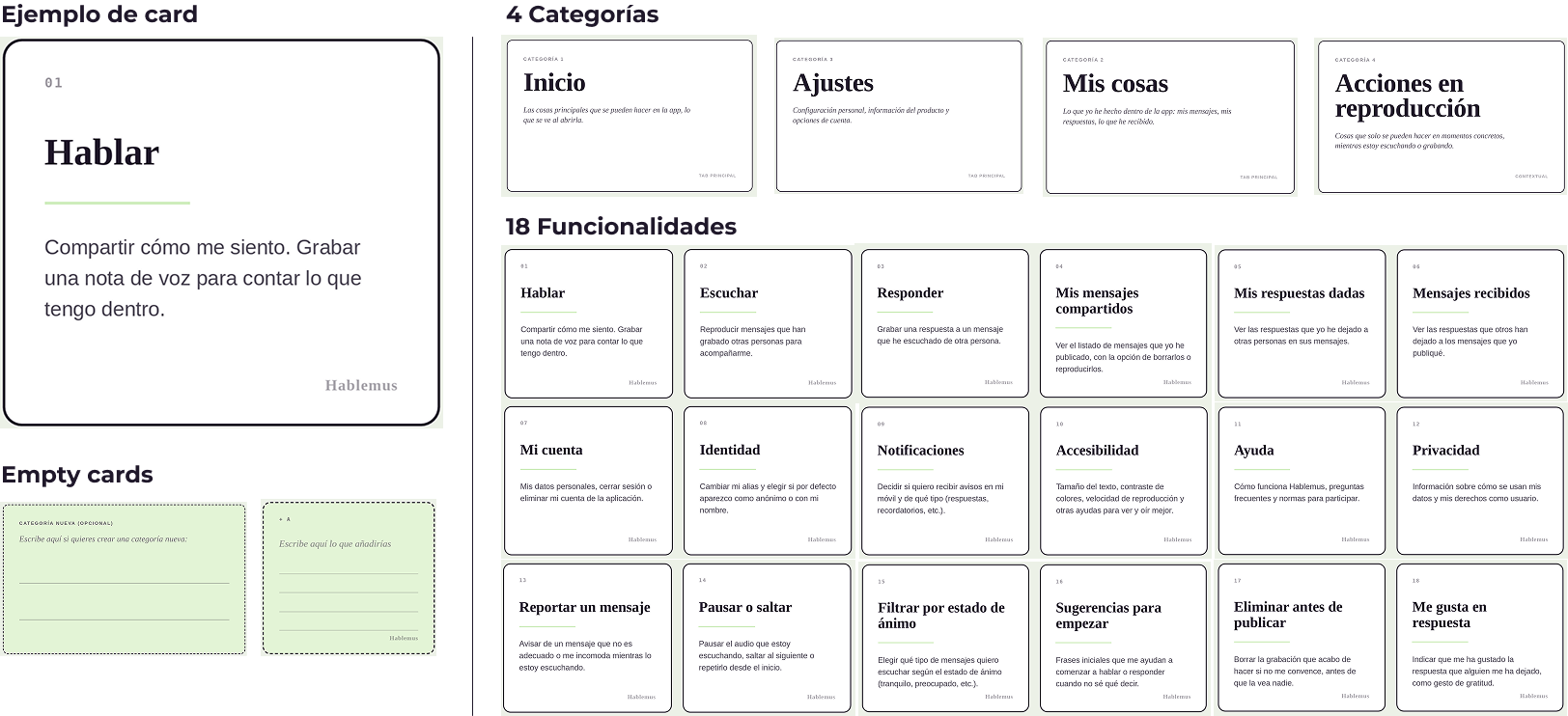
The resulting categories informed the main tabs, labels and first pass navigation structure.
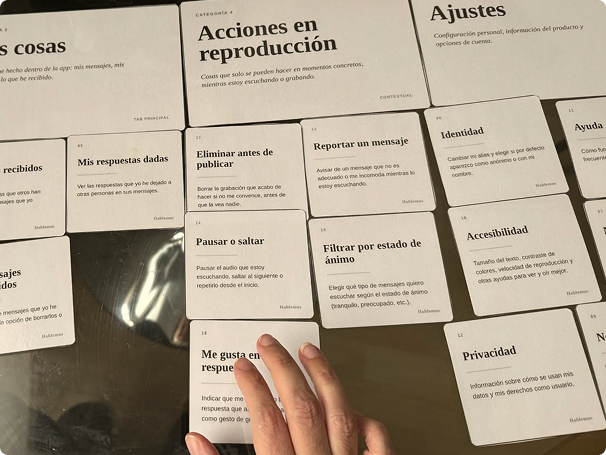
The exercise validated category groupings while also revealing the labels that felt natural, confusing or ambiguous for the audience.
Most cards landed consistently in the same category.
Some cards generated discussion but converged after explanation.
The weakest matches became direct design opportunities.
Screens
Main tabs
Max nav levels
Modals
After validating the flow in Figma, I rebuilt the experience in HTML, CSS and JavaScript to test real microinteractions, audio recording and behavior close to production.
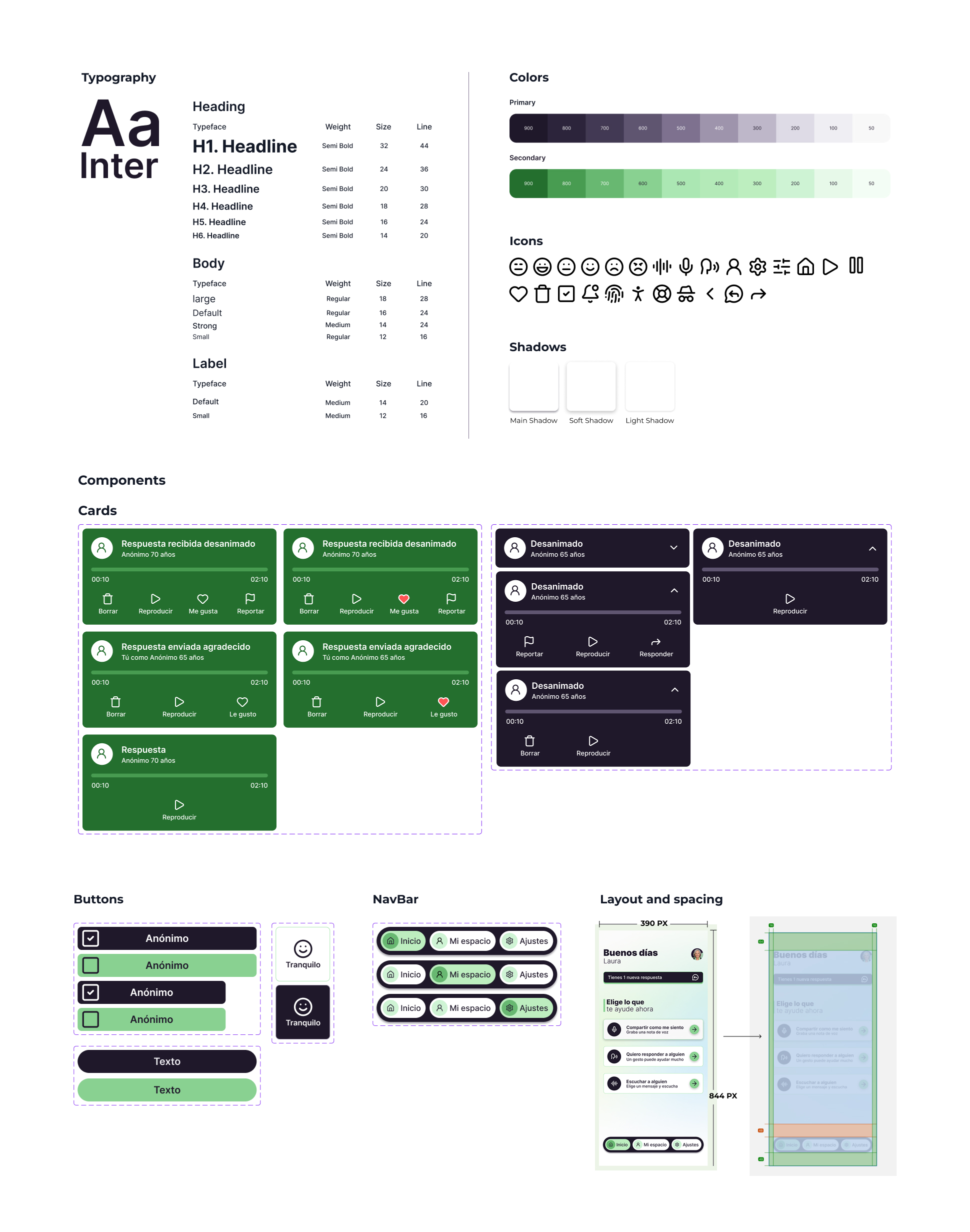
Inter for legibility, a two-tone green palette and oversized touch targets.
The exact build used in usability testing is embedded below.
I designed the usability test so participants could stay inside the experience while completing tasks and giving lightweight feedback. This reduced friction and made the sessions easier to follow for older adults.
Sessions were completed remotely and in person to validate the main flows of the MVP.
Users completed sharing, replying, listening, checking activity and identity related actions.
Each step captured completion, perceived ease on a 1 to 5 scale and a short qualitative note.
A standard usability score complemented the qualitative feedback gathered during the tasks.
A final conversation helped connect the numbers with the actual experience behind them.
The focus was on understanding where the product created confidence and where it still demanded unnecessary effort.
All participants completed all five tasks successfully.
The product scored above the 80 point excellence threshold.
Sharing and listening required more effort than the rest of the flows.
Scale 1 to 5. 1 = very difficult. 5 = very easy.
Completion was high, but ease varied. That gap between finishing and finding it effortless revealed the next design opportunities.
Participant #2“It feels simple, and that gave me confidence.”
On friction“Some names made me stop and think for a second, but I could still complete the tasks.”
On potential“I can see how this could help many older adults who need to talk without being judged.”
Anonymous voice messages, listen-only mode, optional responses and a fully asynchronous experience, validated with real users.
Respond directly from Listen, rename “My Space” as message history and add more nuanced moods.
Connect people through similar experiences and provide empathetic response guides.
Protect sensitive content and recommend messages based on emotional context.
Evolve Hablemus into a bridge toward trained emotional-support professionals without losing its low-pressure nature.
Up next
MyConsole . Paack